


The Unsung Heroes of Construction; Why Suppliers & Vendors Deserve More Credit in Construction Tenders

posted in: General 0

In the construction industry, the spotlight often falls on developers, project managers, and main contractors. Yet behind every successful tender submission lies a network of vendors and suppliers whose expertise, pricing accuracy, and technical input make competitive bidding possible.

Without them, many tenders simply could not be priced, least not with confidence.

When a main contractor prepares a tender submission, time is limited, drawings may still be evolving, specifications may be incomplete. Risks are often unclear. In this environment, suppliers and specialist subcontractors step in, their input forms a significant proportion of the final tender price, especially in specialist trades.

In effect, vendors and suppliers absorb early-stage commercial risk to enable contractors to submit competitive bids, and they do this without any guarantee of securing the order.

Their pivotal role enables accurate, competitive tender submissions.

Their real-time market knowledge is critical for accurate tender pricing.

In many cases, early supplier engagement allows contractors to structure their programme in a way that strengthens their tender submission.

Main contractors who build strong, respectful supplier relationships often see tangible benefits such as faster turnaround on quotes and more competitive pricing.

Vendors and suppliers aren’t just part of construction,they are essential to it, they are foundational to it.

Every competitive tender submission reflects hours of unpaid effort, technical analysis, and market insight from the supply chain. and without them, the construction industry simply could not function.

Behind every tender submission is a network of companies who helped, they gave their time, they shared their knowledge, they offered their pricing.

They don’t usually get the recognition, but they absolutely deserve it, as they are critical to tender success.

If we want a stronger, more resilient construction industry, it starts with valuing the people who helped you win the work in the first place.

__________________________________________________

If you are interested in becoming one of our subscribers, please visit Leads 2 Business.
To view notes with screenshots on how to use our website, please visit Leads 2 Business Wiki.
To view more Featured Companies, please visit our Leads 2 Business Blog

About Lola Govender

With nearly 18 years at Leads 2 Business, I have developed a deep appreciation for the value we provide as a trusted information partner within the industry. Being part of a company that consistently supports business growth and opportunity creation has been both rewarding and inspiring. I am passionate about teamwork, meaningful networking, and building strong, lasting relationships with our subscribers. I take pride in delivering service excellence and contributing to a collaborative environment where our clients feel supported and valued.
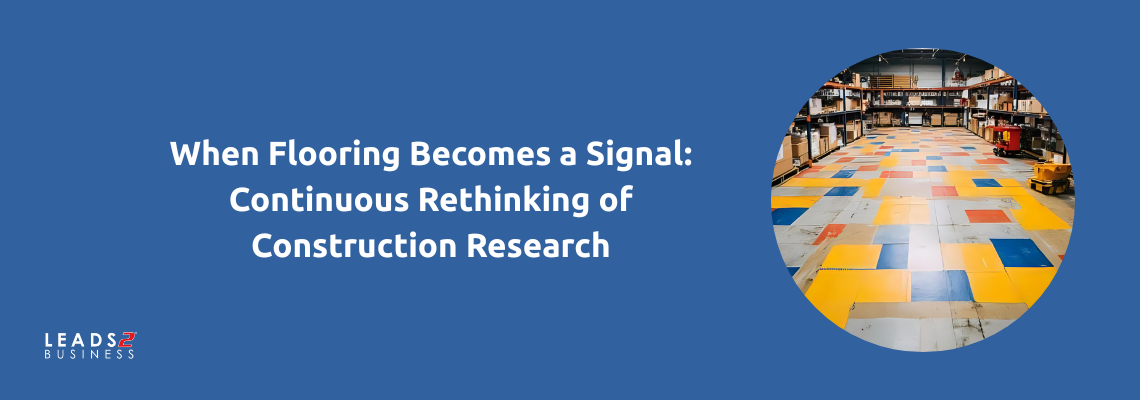
When Flooring Becomes a Signal: Continuous Rethinking of Construction Research

posted in: General 0

The work of a construction industry researcher is rarely about raw data alone. At its core, research in this sector is an act of continuous learning, of paying attention to the subtle ways in which projects unfold, and of listening to the people who inhabit the spaces between drawings and delivery. Because data without alignment to industry reality is, at best, inert and at worst, misleading.

That alignment is often maintained through feedback. Over the years, I have come to realize that my clients are not only recipients of my work; they are also my most valuable collaborators. They are, in effect, my feelers on the ground; the first to notice when something shifts in practice before it shows up in statistics.

About two months ago, one of those clients called me with what sounded, at first, like a small observation. In private tenders for factory warehousing and distribution centers in Gauteng, he noticed that the initial Bills of Quantities are now often omitting the flooring component. Instead, flooring contractors were approaching rebar suppliers, concrete specialists, and others at later
stages, requesting rates after the Principal Contractor appointment tender process was already underway.

This was not entirely new, late-stage coordination has always existed in pockets of the industry. But what mattered here was scale. In Gauteng, this was no longer an anomaly. It was happening often enough that my client flagged it as something I needed to pay attention to. And when Gauteng speaks, the rest of the country often than most, starts listen. As South Africa’s economic
powerhouse, what emerges here often sets the pace for practices elsewhere.

The insight was simple but profound: if flooring is being treated not as an upfront design element but as a downstream addition, the dynamics of procurement and influence shift. For suppliers, this creates a new niche. Traditionally, many invest their resources in getting listed on main contractors’ preferred supplier databases. That made sense when the main contractor was the unambiguous
gatekeeper. But if flooring contractors are now shaping procurement decisions at later stages, then ignoring those relationships could mean missing opportunities.

This realization changed the way I approached my research for the region. Monitoring such trends does more than keep our work relevant, it allows us to help clients reimagine their own strategies. Instead of viewing success solely as access to the main contractor, they might also consider building relationships with specialized players in the flooring sector, in this instance. Widening their reach in
this way is not just tactical; it is adaptive.

At Leads 2 Business, we are intermediaries, bridging gaps in the flow of information. And at a deeper level, what we offer is not simply data but a framework: the ability to see emerging signals, however small, and to translate them into an architectural blueprint for decision-making. That, ultimately, is what allows companies to build not only pipelines of work but also resilience in uncertain markets. In research, the most important insights rarely come from numbers alone. They emerge from conversations, observations, and anomalies that demand a closer look. A missing flooring line item on a Bill of Quantities may not seem like much, until you realize it is pointing to a larger structural shift.

And perhaps that is the lesson for the wider industry: in construction, transformation often begins at the margins with details that seem incidental but in fact signal deeper movements. The task for researchers, suppliers, and contractors alike is to remain open to these signals, to read them not as noise but as intelligence. For those who do, the advantage lies not in predicting the future but in
recognizing it as it quietly arrives.

If you are interested in becoming one of our subscribers, please visit Leads 2 Business.
To view notes with screenshots on how to use our website, please visit Leads 2 Business Wiki.
To view more articles, please visit our Leads 2 Business Blog

About Minnie Zondi

I am an insanely optimistic ambivert that does everything from the heart instead of the mind. Deeply interested in people and matters that pertain to mankind.